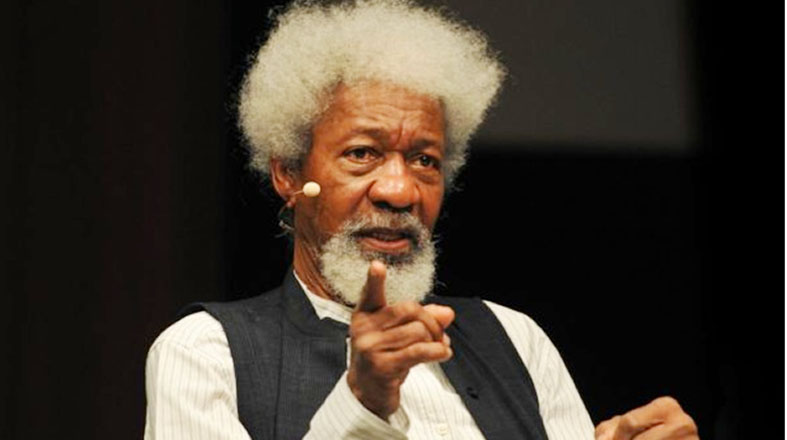
Nobel laureate Prof. Wole Soyinka has raised concerns over what he described as an unusually large security detail assigned to one of President Bola Tinubu’s children, saying such deployments distort Nigeria’s security priorities at a time of widespread national threats.
Soyinka spoke on Tuesday at the 20th Wole Soyinka Centre for Investigative Journalism (WSCIJ) Awards in Lagos, where he narrated a recent encounter that left him unsettled. According to him, he stumbled upon what looked like a full military operation at a hotel in Ikoyi.
“I was coming out of my hotel, and I saw what looked like a film set,” he said, recalling how a young man from the crowd greeted him politely. “I looked around and there was nearly a whole battalion occupying the hotel grounds.”
Soyinka said he later learned the heavily armed team—about 15 officers—was assigned to the president’s son. The scale, he noted, struck him as extreme.
“When I got back in my car and asked the driver who the young man was, he told me,” he said. “And I saw this SWAT team, heavily armed to the teeth. They looked sufficient to take over a neighbouring small country or city like Benin.”
Confused by the level of deployment, Soyinka said he attempted to contact the National Security Adviser to confirm whether the arrangement was officially sanctioned.
“I began looking for the NSA immediately,” he said. “I described the scene and asked: ‘Do you mean a child of the head of state goes around with an army for his protection?’ I couldn’t believe it.”
With characteristic irony, Soyinka added that such a force could easily be redeployed for national defence.
“Tinubu didn’t have to send the air force or military to deal with any insurrection,” he said jokingly. “Next time there’s an uprising, the president should call that young man and say, ‘Seyi, go and put down those stupid people there. You have troops under your command.’”
The literary icon stressed that while it is normal for presidents to secure their families, it becomes problematic when such protection grows into what he called an unnecessary show of force.
“Children should know their place. They are not potentates; they are not heads of state,” he said. “The security architecture of a nation suffers when we see such heavy devotion of security to one young individual.”
Soyinka’s remarks feed into a wider public conversation about the scale of state security allocated to politically connected individuals amid persistent insecurity across Nigeria.