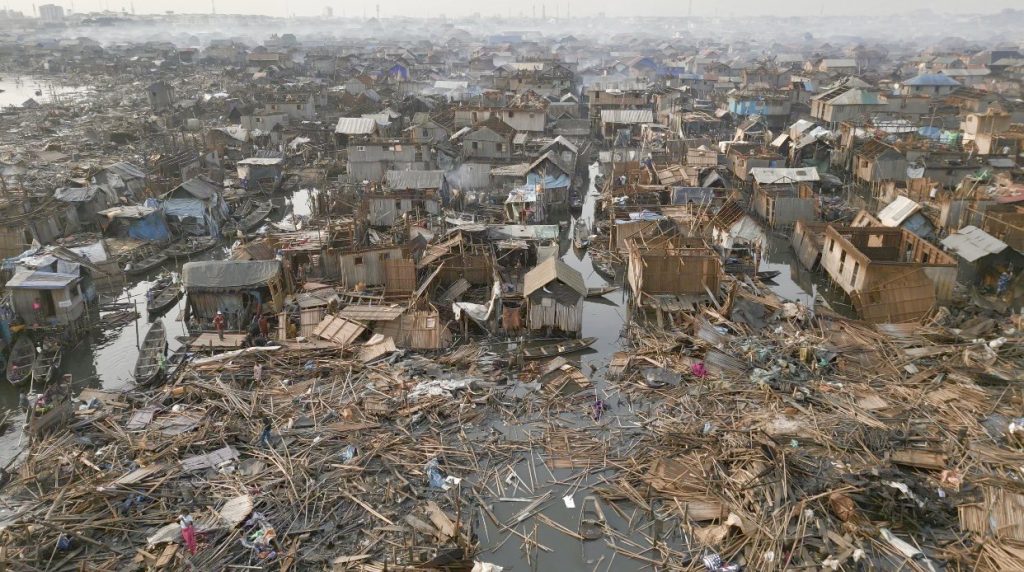
Makoko, the historic floating fishing settlement in Lagos, has been plunged into a humanitarian crisis following an ongoing demolition exercise by the Lagos State Government that has left thousands of residents homeless and destitute.
Women, children, widows and the elderly are now sleeping in canoes, under open skies and beside the lagoon, after entire rows of wooden homes and shops were pulled down. What remains are broken planks, scattered belongings and a community struggling to survive.
Often described as Africa’s largest floating slum, Makoko is home to fishermen, traders and artisans whose livelihoods are deeply tied to the lagoon. For many residents, the demolitions have not only destroyed their homes but also wiped out their means of survival.
Residents say the demolition started quietly in parts of Makoko in December 2025 before gradually expanding deeper into the community with little engagement or consultation.
“They started from one side and kept moving,” said Mr Sunday Adebayo, a community elder who has lived in Makoko for over 20 years.
“At first, we thought it would stop. Then it kept coming closer. Every day, one house after another. By January, it became massive. That was when we knew they wanted to wipe us out all in the name of development and infrastructure. Everything we own don finish.”
Before the demolitions, residents survived through fishing, trading and small-scale businesses operated from their homes. Those livelihoods have now vanished.
A 35-year-old fisherman, Oyomide, said survival has become almost impossible.
“Na this water we dey take survive. I dey go fishing every morning, my wife dey smoke fish, we dey sell small-small. But when dem break house, everything go. My net spoil. My canoe nearly sink. Since that day, we never chop better food.”
A mother of four described hunger as their new reality.
“Before, even if money no dey, we go find something chop. Now, nothing dey. No shop, no house, no work. Sometimes my children go sleep without food. As a mother, e dey pain me well well. Every night I dey cry, how I go raise my children?”
Several residents said they lost cash savings, fishing equipment and household items without warning.
“They no even give us time. I no fit pack anything. My money, my radio, my mattress — everything don go,” an elderly resident said.
Many residents say Makoko is the only home they have ever known.
“My father lived here. I was born here. I grew up here. Now my children live here. For more than 40 years, this is the only home we’ve known,” said 52-year-old fisherman Balogun Adekunle.
Mrs Bidemi, a widow with three children, said she has nowhere else to go.
“My husband died five years ago in an accident. This house was all we had. Now it is gone. I am alone. Where do they expect me to go?” she cried.
Displaced residents say no temporary shelter or IDP camp has been provided.
“If rain fall, na rain go beat us. If sun hot, na sun go burn us. Mosquito no dey fear anybody. Dem break my shop. How my children wan chop?”
A father of five said his children are constantly ill.
“My pikin dey cough every night. Cold dey worry dem. We no get roof again. I no know wetin go happen tomorrow.”
Some residents allege demolitions were carried out overnight.
“One night, after midnight, we heard noise. Before we knew it, houses were coming down. People were shouting. Children were crying. Nobody listened,” said Mr Adekunle Hassan.
Others claimed some structures were set ablaze.
“They burnt houses while people were still inside. We ran out with only the clothes we wore. Everything burned,” alleged Mrs Blessing Okonkwo, whose shop was destroyed.
Parents say their children have dropped out of school due to loss of income and destroyed belongings.
“My two children stopped going to school. Their uniforms were destroyed. I have no money,” said Mrs Esther Ajayi.
Teachers in nearby schools confirmed a sharp drop in attendance among pupils from Makoko.
Residents and civil society groups allege that at least 12 deaths have occurred in connection with the demolitions, linked to stress, illness and displacement.
“My brother was healthy before. After they destroyed our house, he fell sick. We had no money for hospital. He died quietly,” said Mr Ibrahim Lawal.
Another resident said shock killed her elderly mother.
“She kept asking where we would sleep. She could not take it anymore.”
The Lagos State Government has not confirmed these deaths.
The state government maintains that the demolished structures were built under high-tension power lines and posed serious danger.
Governor Babajide Sanwo-Olu said the buildings had been marked long ago and that compensation was being arranged.
However, residents dispute the claim.
“Some houses they destroyed are more than 500 metres away from the cables,” said Mrs Funke Olawale.
On January 20, 2026, the Lagos State House of Assembly backed the demolition, saying it was necessary to protect lives and enforce the law.
“It is quite worrisome that shorelines have turned to abodes of miscreants and criminal elements,” said House Committee Chairman Stephen Ogundipe, adding that the demolition, though painful, was necessary.
Residents disagreed.
“We protested. We cried. But they chose development over our lives,” said youth leader Mr Adewale.
Former Education Minister Oby Ezekwesili condemned the demolitions as inhumane and unconstitutional.
“What we are seeing is not safety. It is systemic violence against the poor,” she said.
Sanwo-Olu countered that the action was about safety and accused some NGOs of exploiting the situation.
APC chieftain Joe Igbokwe also raised concerns, alleging that many Igbo homeowners in Lagos have suffered similar demolitions without fair compensation.
“I am besieged, exhausted and desperate for a solution. I want peace and understanding,” he said.
As night falls on Makoko, fear and uncertainty loom. Fishermen stare at the lagoon, unsure if they can still fish. Parents worry about feeding their children.
For now, Makoko remains a community floating between loss and uncertainty — a stark reminder that development, when poorly managed, can destroy lives faster than it builds cities.