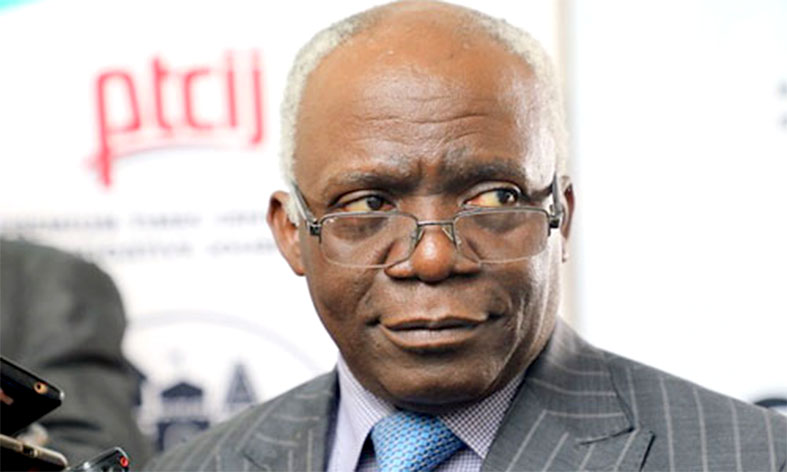
Human rights lawyer, Femi Falana (SAN), has challenged the Minister of the Federal Capital Territory (FCT), Nyesom Wike, to cite any law empowering him to declare a public holiday and restrict movement during the recently concluded Area Council election in Abuja.
In a statement issued on Monday, Falana described the minister’s action as unlawful and beyond his statutory authority, insisting that the power to declare public holidays is clearly defined under Nigerian law.
“My comment was anchored on the relevant provisions of the relevant laws of the land,” Falana said. “I wish to state, without any fear of contradiction, that only the President and the Minister of Interior can declare public holidays for the entire country or in the FCT, while governors are empowered to declare holidays in their states. The FCT Minister is not so empowered.”
The Senior Advocate of Nigeria further argued that even if the President had authorised Wike to impose movement restrictions during the election, a claim he disputed, such approval would not extend to declaring a public holiday.
“Assuming without conceding that the President authorised the Minister to restrict movement during the election, did that include the public holiday?” Falana queried.
He noted that many residents appeared to have ignored the declared holiday, pointing out that courts in the FCT sat and heard cases, while security agencies did not enforce compliance.
Falana also raised questions about the minister’s own conduct during the restriction period.
“By the way, did the Minister comply with the restriction order on Saturday? Did he register to vote in the FCT? Did the restriction order permit him to move around during the restriction of movement? Did the restriction order permit him to interfere in the election by interrogating electoral officers?” he asked.
Dismissing claims that the President authorised the directive, Falana described such justification as legally untenable. He argued that the President lacks the constitutional power to issue directives concerning the conduct of elections.
Citing Section 160(1) of the 1999 Constitution (as amended), Falana emphasised that the regulation and conduct of elections fall exclusively within the authority of the Independent National Electoral Commission (INEC).
“The powers of INEC to make its own rules or otherwise regulate its own procedure shall not be subject to the approval or control of the President,” he stated.
Falana maintained that any executive action affecting election conduct, including movement restrictions, must not undermine the constitutional independence of the electoral body.
“I challenge the FCT Minister, Mr. Nyesom Wike, to refer to any law that empowers him to declare a public holiday or restrict the movement of citizens during the just concluded area council election,” he added.