By: Odeh Favour Adiya
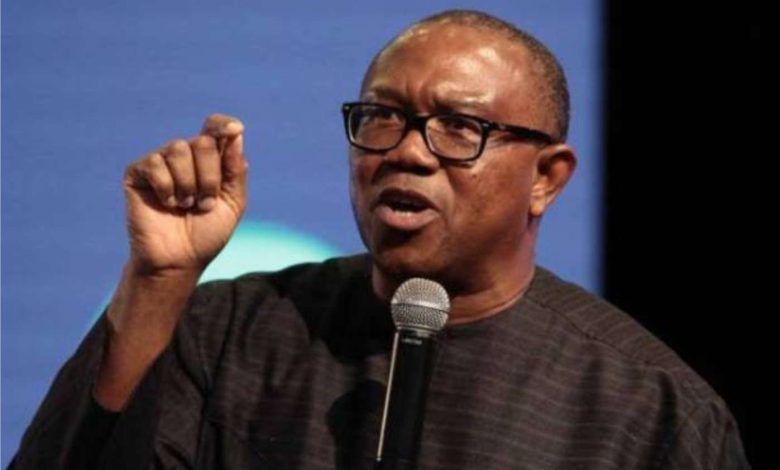
The presidential candidate of the Nigeria Democratic Congress (NDC), Peter Obi, has taken to his X handle to criticize the Federal Government over recent verbal attacks directed at the Catholic Bishops’ Conference of Nigeria (CBCN) and John Cardinal Onaiyekan by presidential aides and supporters.
In a post titled “When a Government Declares War on the Truth,” Obi expressed concern over the administration’s handling of constructive feedback, stating that Nigeria’s challenges continue to deepen as the government becomes “increasingly intolerant of truth and hostile to those who speak about the suffering of the people.”
Highlighting the global perception of the country’s trajectory, Obi recalled that U.S. President Donald Trump recently described Nigeria as “a now disgraced country.” He noted that each passing day exposes deeper signs of decline within the polity.
Defending the role of faith-based groups in national development, the former Anambra State Governor stated that the Catholic Church has never acted as an opposition party. Instead, alongside other prominent religious organizations such as the Christian Association of Nigeria (CAN), Jama’atu Nasril Islam (JNI), the Supreme Council for Shari’ah in Nigeria (SCSN), and the Nigerian Supreme Council for Islamic Affairs (NSCIA)—it has consistently served as the conscience of the nation across both military and civilian administrations.
“The bishops merely expressed what millions of Nigerians experience daily: insecurity has worsened, poverty is deepening, inflation is crippling families, businesses are struggling, and hope is fading,” Obi wrote, questioning why the administration reduced broad national concerns to a “religious affair.”
Obi faulted attempts to exploit religion and ethnicity for political division, asking whether economic hardship, unemployment, and kidnappings recognize tribal or religious boundaries.
Drawing from historical precedent, Obi recalled that when Pope John Paul II visited General Sani Abacha in 1998 and raised issues regarding the incarceration of Chief Moshood Abiola, he was not vilified.
He further observed a contrast in leadership posture, pointing out that President Bola Tinubu demonstrated deep respect for the Catholic Church when he arrived in Rome days ahead of dignitaries like U.S. Vice President JD Vance for the inauguration of Pope Leo XIV, yet his administration now displays hostility toward church leaders at home.
The NDC flagbearer strongly condemned the aggressive responses directed at elder statesmen within the clergy, particularly Cardinal Onaiyekan. Highlighting Onaiyekan’s record including scoring the best Higher School Certificate result in the old Northern Region in 1962 and rising through the ranks to become a papal-eligible Cardinal Obi cautioned that personal attacks against such respected figures weaken public discourse.
Reflecting on his tenure as governor of Anambra State, Obi noted that his administration drew strength from strong traditional and religious institutions that offered consistent criticism.
Citing Napoleon Bonaparte’s preference for hearing bad news to identify operational problems, Obi argued that effective governance relies on honest feedback rather than sycophancy.
“When governments punish truth-tellers and reward sycophants with appointments, honest advisers withdraw, sycophancy thrives, and leaders become disconnected from reality,” Obi warned.
Concluding his statement, Obi maintained that the CBCN did not insult the President and urged religious leaders to remain steadfast in speaking truth to power. He added that silence in the face of suffering would betray their moral obligation, reiterating that “a leader who hears only praise will never fully understand the pain of his people or find the clarity needed to correct what is wrong.”