By: Odeh Favour Adiya
The Nigerian Army on Thursday commenced a seminar in Kaduna aimed at strengthening the capacity of its engineers to counter the growing threat of Improvised Explosive Devices (IEDs) in contemporary security operations.
The seminar, organised by the 41 Engineer Brigade, 1 Division Nigerian Army, formed part of activities marking the graduation of the Explosive Ordnance Disposal (EOD) X2 Course 126.
Speaking at the event, the Commander, Corps of Engineers, Maj.-Gen. S.T. Shafaru, represented by Maj.-Gen. Josiah Attah, said the training was aimed at equipping Nigerian Army engineers with the skills required to effectively support ongoing military operations across the country.
Shafaru said the training initiative aligned with his vision of improving the adaptability and resilience of the Nigerian Army in joint and multi-agency operations.
He noted that newly recruited personnel posted to the Nigerian Army Corps of Engineers undergo basic combat engineering, field engineering, and artisan training at the Nigerian Army School of Military Engineering to prepare them for specialised engineering assignments.
According to him, the Explosive Ordnance Disposal course was introduced to bridge the shortage of EOD specialists and enhance the corps’ operational capability.
“Improvised Explosive Devices have become one of the greatest security threats confronting the Nigerian Army in ongoing counter-insurgency operations. Their widespread use has complicated military operations and humanitarian activities in conflict-affected areas,” he said.
Shafaru explained that Army engineers routinely conduct clearance operations to detect and remove explosive devices before troops and civilians use affected routes, while EOD specialists are trained to identify, disarm, and safely destroy explosives.
He added that the corps had continued to collaborate with other security agencies and international partners, including the British Military Assistance Training Team and the German Training and Assistance Group, to improve technical expertise and intelligence sharing.
He further revealed that he had directed the upgrade of facilities at the 41 Engineer Brigade Training School and the provision of additional training aids to improve realistic training.
Describing the seminar as timely, Shafaru said the increasing use of IEDs across operational theatres underscored the need for continuous capacity building. He disclosed that the German Training and Assistance Group had been supporting participants of the Medium Explosive Ordnance Disposal Course at the Nigerian Army School of Military Engineering.
He also stressed the importance of public awareness campaigns in encouraging citizens to report suspicious objects and activities that could help security agencies prevent attacks.
In his goodwill message, the General Officer Commanding 1 Division Nigerian Army and Commander, Sector 1, Operation FANSAN YAMMA, Maj.-Gen. Abubakar Wase, represented by the Garrison Commander, Brig.-Gen. Anwar Abdullahi, described the seminar as a platform for troops and sister security agencies to exchange ideas on tackling IED threats.
Wase said the programme aligned with the third pillar of the Chief of Army Staff’s Command Philosophy, which emphasises operational readiness through continuous mission-oriented training and doctrinal innovation.
He urged participants to apply the knowledge gained during the seminar in their respective formations and operational theatres.
Earlier, the Commander, 41 Engineer Brigade, Brig.-Gen. Sheriff Aremu, said the seminar was the first of its kind in 1 Division and was organised alongside the graduation of Explosive Ordnance Disposal X2 Course 126.
According to him, the course, which commenced on June 12, had 31 participants drawn from units under the 41 Engineer Brigade and one personnel from the Nigerian Army School of Military Police within the division’s area of responsibility.
Aremu said the training became necessary because of the increasing threat posed by IEDs, particularly in Operation FANSAN YAMMA and other ongoing military operations.
“The training course to counter the emerging threat of Improvised Explosive Devices in the theatre is not only a welcome development but a timely intervention,” he said.
He added that the seminar would deepen participants’ understanding of the operational, tactical, and psychological effects of IEDs while promoting effective counter-IED measures through expert presentations and interactive sessions.
Aremu commended the National Counter-Terrorism Centre and other stakeholders for supporting the training, and urged the graduating participants to demonstrate professionalism and apply the skills acquired during the course.
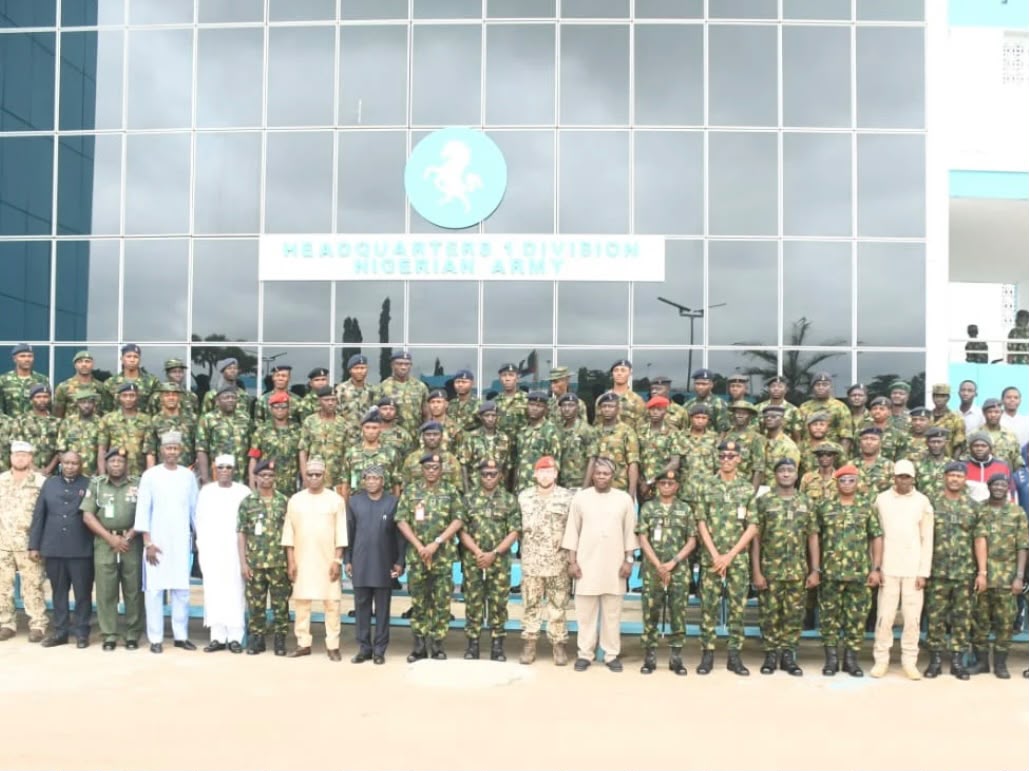
The seminar attracted senior military officers, commanders, commandants of Army formations and schools, principal staff officers of 1 Division, resource persons, and representatives of other security agencies.
It is expected to enhance collaboration among security stakeholders and improve the Nigerian Army’s preparedness to detect, manage, and neutralise IED threats in ongoing operations.