By: Odeh Favour Adiya
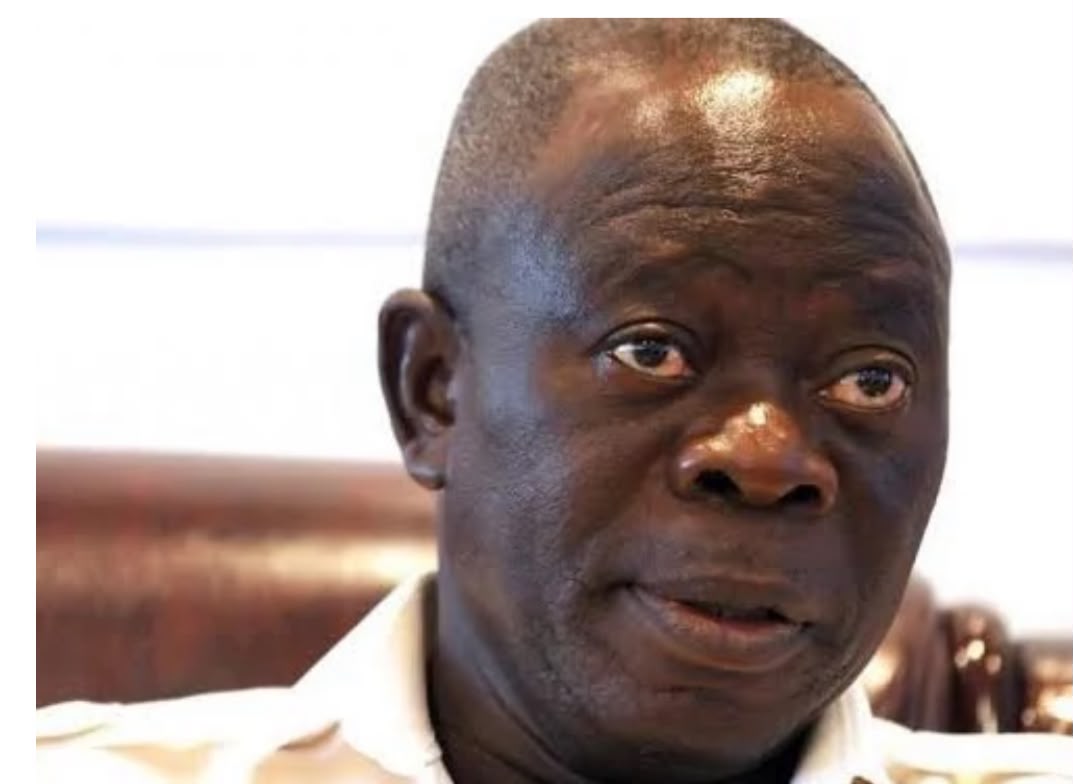
The Senator representing Edo North, Adams Oshiomhole, has dismissed suggestions that the Labour Party’s presidential candidate in the 2023 election, Peter Obi, poses a major political threat to the ruling All Progressives Congress ahead of the 2027 general election.
Speaking on Monday during an appearance on TVC News’ Beyond The Headlines, the former Edo State Governor argued that Obi’s performance in the 2023 presidential election was largely driven by public anger over the economic policies of former President Muhammadu Buhari’s administration rather than personal political strength.
Responding to a question on whether the APC was underestimating Obi’s political influence—particularly following his victory in Lagos State and strong showing across the South-East region Oshiomhole maintained that the former Anambra State governor merely benefited from a uniquely chaotic political environment.
“No, not at all, not at all. Obi was produced by an unusual situation when a ruling party decided to destroy itself, making anybody running on its platform almost unelectable. It was that confusion that produced those votes,” Oshiomhole said.
The former Nigeria Labour Congress President blamed the severe cash crunch caused by the naira redesign policy alongside widespread fuel scarcity on the eve of the 2023 elections for fueling voter frustration. According to him, Nigerians were pushed to the edge after being unable to access their hard-earned money deposited in commercial banks.
“People had money in the bank but couldn’t access it. They queued all night at ATM machines just to withdraw ₦10,000, and after a week, even the ATMs were dry,” he stated.
Oshiomhole noted that the severe cash shortage forced many citizens to pay exorbitant transaction fees to Point of Sale operators just to obtain basic cash for daily survival.
Recalling encounters with his constituents, he recounted: “A woman in my village told me, ‘You said I should keep my money in the bank, but when I went to collect it, they said there was no money. At the POS, they deducted ₦2,000 from ₦5,000. How do I survive?’”
The lawmaker insisted that voters had already grown disillusioned with the main opposition Peoples Democratic Party before the APC-led federal government introduced anti-people economic policies that exacerbated public hardship right before the polls.
“Someone asked why people would queue all night to withdraw ₦5,000, then queue again for fuel, and still expect them to queue on election day to vote for the same government. That anger was what produced Obi,” he added.
Oshiomhole maintained that the policies responsible for the widespread hardship were not part of the APC’s political agenda.
“I told her what Buhari was doing at that time was not APC policy. It was that anger that influenced the outcome of the election,” he said.