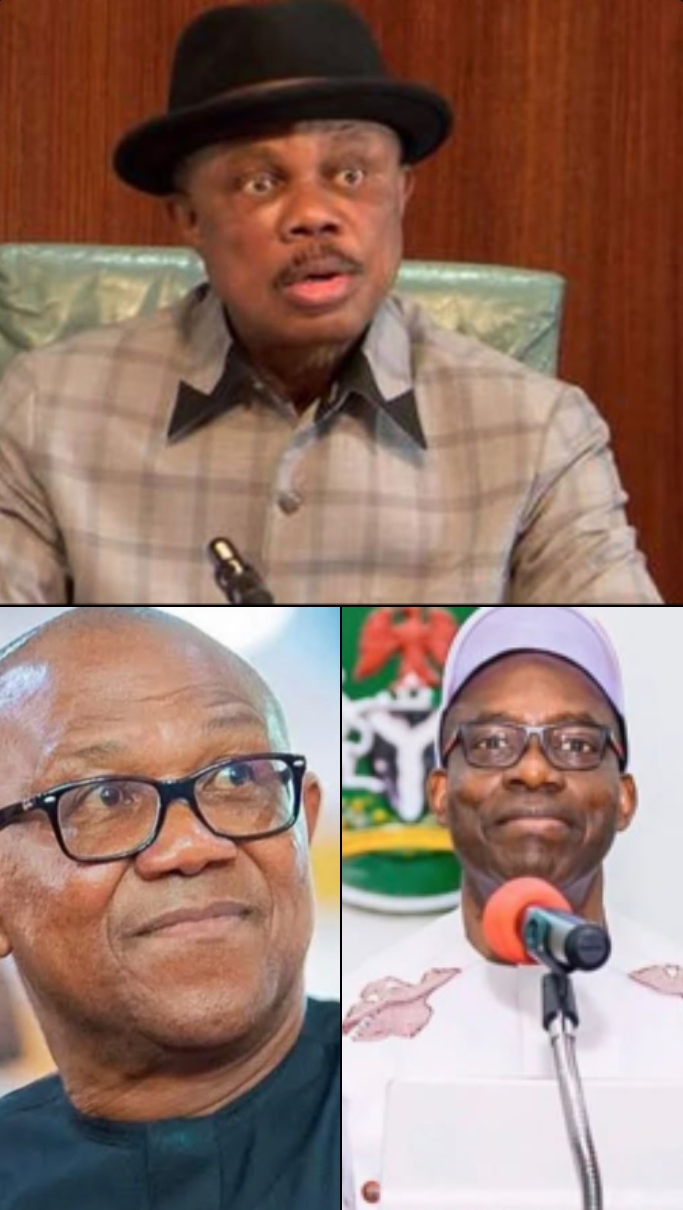
The Anambra State Government and former governor Peter Obi have renewed their dispute over the state’s financial position at the end of his tenure, with the government alleging that billions of naira in loans and other liabilities remained outstanding when he left office in 2014.
The government, in a statement issued on Wednesday by the Commissioner for Information and Value Reorientation, Law Mefor, described Obi’s claims that he left the state without outstanding debts or financial obligations as “wild” and “verifiably false.”
According to Mefor, eight external loans obtained or inherited during Obi’s administration had a combined outstanding balance of $92.35 million, which the government valued at N127.37 billion as of June 30, 2026.
The loans, the statement said, were used to finance projects in areas including malaria control, erosion management, healthcare, education, community development, Fadama development and agricultural value chains.
Among the facilities listed was a $48.33 million additional financing for the Malaria Control Booster Project, with $37.34 million still outstanding as of June 30, 2026.
The government also cited a $37.89 million Nigeria Erosion and Watershed Management Project loan, of which $34.86 million remained unpaid.
Mefor said the loans were currently being serviced by the state government, stressing that the administration did not consider borrowing itself to be improper when funds were deployed to viable projects and human-capital development.
“Evidently, HE Peter Obi borrowed for malaria, erosion control, education, healthcare, etc. So far, this government pays hundreds of millions of Naira every month to service these debts and we are not complaining,” the commissioner said.
“It is good for Anambra once we can show the impacts.”
The government also challenged Obi’s assertion that he left office without owing workers, pensioners or retirees.
Mefor claimed the Soludo administration inherited and subsequently cleared about N22 billion in gratuity arrears owed to retired state and local government employees as well as teachers.
He further alleged that salary arrears involving workers of the former Anambra State Water Corporation remained unresolved during Obi’s tenure and were still being settled by the current administration.
“This administration has negotiated a settlement and already paid the first two instalments of the agreed three instalment payments,” the statement said.
The commissioner also alleged that some salary, pension and gratuity arrears involving primary school teachers dated back to the administration of former Governor Chinwoke Mbadinuju.
According to him, Obi’s administration verified 16 months of salary arrears and agreed to settle them in instalments but paid only five months.
“This administration has set up a committee headed by the Head of Service to finalise a new verification for us to pay,” Mefor said.
He directly disputed Obi’s claim that no outstanding obligations were left behind.
“So, Your Excellency, you owed salaries, pensions and gratuities. Many of these people are still alive and can testify,” Mefor said.
“It is not good to speak loudly without facts or with fabricated figures.”
The government also rejected Obi’s account of an ecological fund which he said contained more than N2.13 billion when he left office.
Obi had identified a First Bank account, number 2018779464, as the account where the money was kept. He said the funds were released shortly before he left office to tackle the Oko/Umuchiana erosion crisis and were deliberately left untouched for his successor because they were earmarked for the project.
He also argued that the decision was consistent with the principle that “government is a continuum.”
Mefor, however, said a certified statement obtained by the state government showed that the account cited by Obi was an internally generated revenue consolidated account and not an ecological fund account.
“First, the account is an Internally Generated Revenue (IGR) Consolidated Revenue Account, and NOT an ecological fund account,” he said.
“Second, from 2011 when the account was opened until date, there has never been any such amount—whether as inflow or balance—in the account.”
The commissioner subsequently challenged Obi to explain where the alleged ecological fund was kept.
“Since HE Peter Obi raised the issue and admitted that his government received such an amount and it is evident that no such an amount ever entered into the account that he cited, it behoves on HE Peter Obi to tell us where exactly his government kept the money or is the money missing?” Mefor asked.
The state government also disputed Obi’s claim that his administration left more than N75 billion in savings for successive governments.
Mefor described the figure as part of what he termed “nebulous creative accounting,” although the statement did not provide a detailed breakdown of the government’s alternative calculation.
The latest exchange followed Obi’s response to earlier allegations by the Anambra Government that his administration left behind various financial obligations, including an alleged N2 billion liability linked to an ecological fund, unpaid salaries, pensions, gratuities and other commitments.
Obi had rejected the allegations, saying his administration cleared more than N35 billion in historical gratuities and arrears and left office without owing salaries, pensions, gratuities or contractors for duly executed and certified projects.
He challenged anyone with evidence to the contrary to come forward, saying, “If anybody can establish anything to the contrary, I will stop campaigning.”
Mefor said the state government decided to respond because the disputed figures concerned public finances that successive administrations had continued to manage.
“We have no time to join issues. We will simply state the facts here for the records,” he said.
The disagreement has revived the broader debate over the financial records of Obi’s administration, which handed over power to former Governor Willie Obiano in March 2014.
While the former governor maintains that his administration left the state in a financially sound position, the current government has presented figures it says show outstanding loans and other liabilities associated with the period.
The two sides have therefore offered conflicting accounts of the state’s debt, arrears and savings at the point of the 2014 transition, with the Anambra Government insisting that official records should be used to determine the facts.