

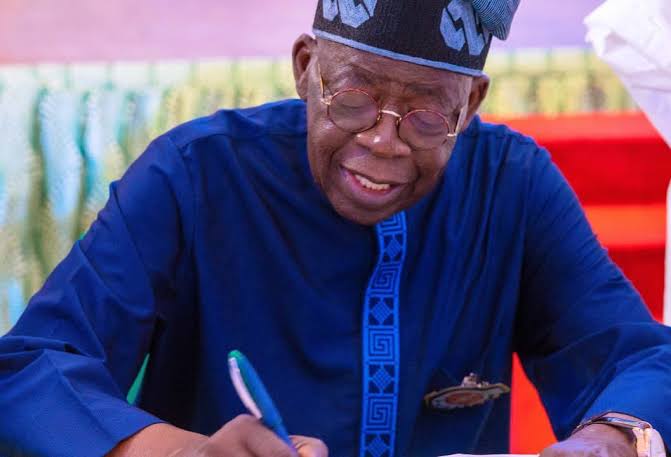
President Bola Tinubu has directed the reconstitution of the All Progressives Congress (APC) Presidential Campaign Council for the 2027 general elections following the uproar that greeted the initial roaster released by the Presidency on Saturday.
According to an exclusive report by The Will, The President’s directive followed concerns from senior members of the ruling party that the composition failed to adequately accommodate key stakeholders and did not sufficiently reflect the hierarchy, geographical spread and political structure of the party.
Senior party sources familiar with the development said that Tinubu directed the Presidency with his Chief of Staff as arrowhead, the leadership of the National Assembly and the National Working Committee (NWC) of the APC to withdraw and review the initial composition and address the identified gaps before a new list is released.
The sources, who spoke anonymously to The Will said the President was embarrassed by the lapses uncovered in the list and particularly concerned about the need for a campaign structure capable of bringing together the party’s major stakeholders and political actors ahead of the 2027 presidential election.
“The President was shocked and surprised that there was limited input from key and experienced people in the party in the final composition of the campaign council”, one of the sources said.
The development comes barely hours after the Presidency announced the initial 223-member campaign council, with former Zamfara State Governor, Senator Abdul’aziz Yari, appointed Director-General.
Uproar Over Exclusion of Key Stakeholders
The initial list immediately generated concerns within the party over the absence of several prominent APC members who are regarded as important political stakeholders in their respective states and regions.
Among the major issues raised was the exclusion of Deputy Speaker of the House of Representatives, Benjamin Kalu.
Kalu is the highest-ranking political office holder from the southeast and one of the party’s most prominent political figures in the zone. His omission from the initial council was viewed by party stakeholders as difficult to reconcile with the need to give the region and the National Assembly appropriate representation in the President’s re-election machinery.
The concerns also extended to the representation of the National Assembly leadership. Under the initial arrangement, the Senate President, Godswill Akpabio, was named a Deputy Director-General for the Southern campaign, alongside the Speaker of the House of Representatives, Tajudeen Abbas, and Yobe State Governor, Mai Mala Buni, while Senate Leader, Opeyemi Bamidele, and Deputy Senate President, Jibril Barau, were assigned coordinating roles.
Party stakeholders questioned the arrangement, arguing that the designation appeared to place the Senate President in a campaign structure alongside or below other officials of the National Assembly who ordinarily rank differently in the constitutional hierarchy.
While Akpabio is constitutionally the third-highest political office holder in the country, after the President and Vice President, the campaign structure did not, in the view of some party stakeholders, sufficiently reflect his institutional position as Senate President.
The sources further said that the new arrangement would need to resolve the perceived imbalance and ensure that the leadership of the National Assembly is properly integrated into the campaign hierarchy.
The sources stressed that the concern was not about individual appointments but about ensuring that the campaign structure reflected the political and institutional realities of the ruling party.
Keyamo, Lalong, Ribadu Among Experienced Figures Missing
The controversy also reinforces an earlier report on prominent APC members with direct experience in presidential campaign management who were not included in the initial roster.
They include former Plateau State Governor, Simon Lalong, who served as Director-General of the APC Presidential Campaign Council for the 2023 election; Festus Keyamo, a senior advocate and former EFCC prosecutor, who was one of the most prominent campaign spokesmen; and National Security Adviser, Nuhu Ribadu, who served as Director of Stakeholders Relations in the 2023 structure.
Former Kogi State Governor, Yahaya Bello, who served as National Youth Coordinator during the 2023 campaign, was also not included in the initial council.
Other notable omissions include former Ogun State Governors, Gbenga Daniel and Ibikunle Amosun, and former Edo State governorship candidate, Pastor Osagie Ize-Iyamu.
Their absence had already prompted questions over whether the new council adequately captured the party’s experienced political operators and its broader network of stakeholders.
The omission of Edo State Governor, Monday Okpebholo, has also emerged as a major point of concern. Okpebholo has been a prominent political voice in the APC’s mobilisation for Tinubu’s re-election and is regarded as an important component of the party’s growing political strength in the South-South.
His exclusion from the initial campaign council, according to party sources, raised questions about whether the structure adequately captured governors who are expected to play central roles in delivering their respective states to the APC in the 2027 presidential election.
The concerns are particularly significant given the importance of state governors to the organisation, mobilisation and electoral coordination of a presidential campaign.
Initial List Considered Too Narrow
Sources familiar with the review said that one of the principal concerns is that the initial list did not sufficiently reflect the APC’s political structure.
The campaign council is expected to serve as the central political machinery for Tinubu’s re-election and, as such, should accommodate key party leaders, governors, National Assembly leaders, experienced campaigners and influential stakeholders across the six geopolitical zones. Instead, the initial structure left out several individuals considered important to the President’s political coalition.
The sources said the review would seek to correct the imbalance and produce a structure that would be more representative of the APC’s leadership and political interests.
Yari’s Appointment Remains Intact
Despite the decision to review the composition, there is no indication that the President has withdrawn the appointment of Yari as Director-General.
Yari’s appointment had been exclusively reported by Theb Will on May 11, when the newspaper disclosed that Tinubu had selected the former Zamfara governor to head his 2027 re-election campaign.
Tinubu Seeks Stronger Campaign Machinery
The President is expected to use the reconstituted council to build a broader political platform ahead of the 2027 election.
In his message to members of the initial council, Tinubu charged them to work towards securing victory for the APC and directed the various directorates to bring other party members into the campaign effort, including those not formally listed.
He said the campaign should focus on the achievements of his administration and its economic reforms.
“We have delivered on our campaign promises and set our country on a path of economic progress. We are definitely out of the dark tunnel and are now at the cusp of reaping the benefits of a prosperous economy that will benefit all Nigerians”, Tinubu said.
He also urged the campaign team to present the administration’s record to Nigerians and inspire support across the country.
“As we march into the campaign season, we have many achievements to trumpet—let us confidently showcase our record and inspire hope in every corner of our nation”, he added.
However, the immediate challenge before the Presidency and the APC leadership is to produce a campaign structure that commands the confidence of the party’s major stakeholders.
The revised list is expected to provide a broader and more politically balanced framework for Tinubu’s 2027 re-election campaign.
Credit: THE WILL


