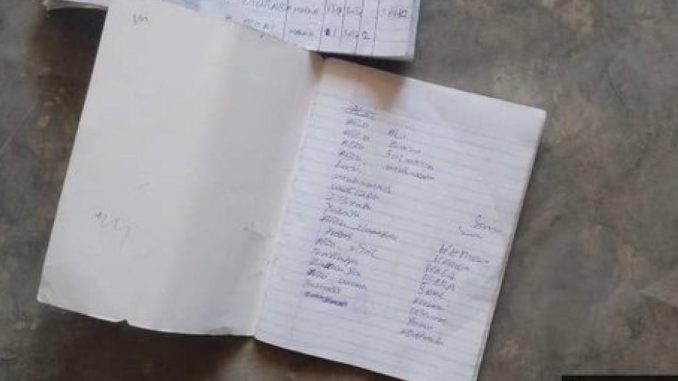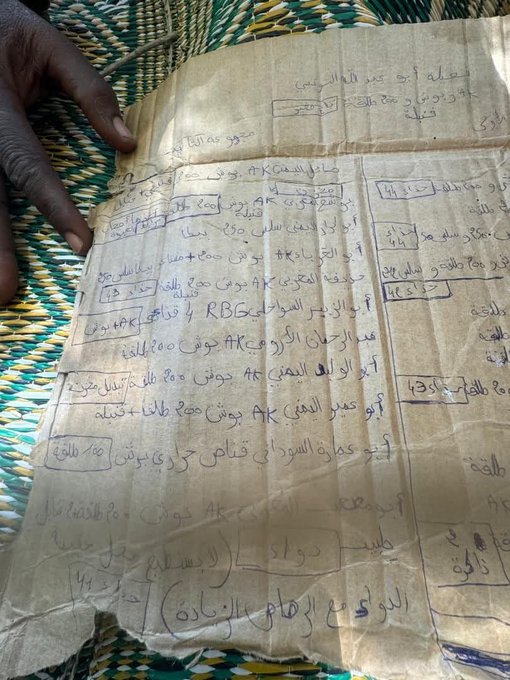
Nigerian troops have recovered notebooks from slain fighters of the Islamic State West Africa Province (ISWAP) in Mallam Fatori, offering insight into the group’s planning and operational structure.
The documents reportedly contain lists of fighters mobilised for attacks, alongside details of their assigned roles, weapons, and allocated ammunition.
Security analyst and researcher Brant Philip, in a social media post on Wednesday, said similar organisational patterns have been observed in other Islamic State affiliates, including in Puntland under IS-Somalia, suggesting a coordinated and structured approach across regions.
“Notebooks captured by Nigerian troops from slain ISWAP fighters in Mallam Fatori show the list of militants mobilised for the attack, their roles, their weapons and their allocated ammunition,” he said.
He added that comparable materials found in IS-Somalia positions also included operational details, even identifying roles such as a cameraman assigned memory cards instead of ammunition.
Philip noted that Islamic State-affiliated groups operate with structures similar to formal institutions, maintaining internal systems such as policing units, military command, and administrative frameworks, reflecting their aim to function as alternative governing entities.
The recovered notebooks are expected to undergo further analysis by security agencies to uncover more details about the group’s personnel deployment, logistics, and communication networks.
The materials were obtained from areas in northeastern Nigeria where ISWAP has carried out attacks.
Meanwhile, on Monday, March 16, 2026, a series of suspected suicide bombings struck Maiduguri, including the Monday Market, one of the largest trading centres in the region.
The explosions, which also affected locations near the University of Maiduguri Teaching Hospital and a central post office junction, killed at least 23 people and left more than 100 others injured, according to local authorities and witnesses.
The attacks occurred during iftar, when residents were breaking their Ramadan fast, increasing the number of casualties. Emergency responders quickly evacuated the injured to hospitals, while security agencies intensified patrols across the city.