

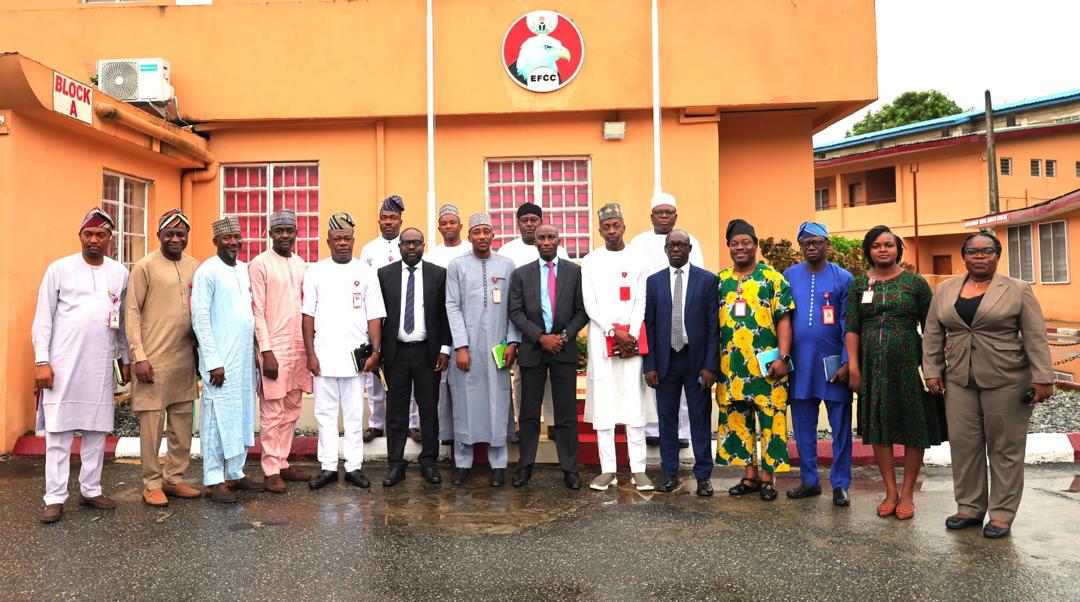
The Economic and Financial Crimes Commission (EFCC) has intensified efforts to enhance its investigative capabilities with a specialised training programme focused on surveillance and intelligence gathering for operatives of its Lagos Zonal Directorate 1.
The capacity-building initiative, organised in partnership with the Department of State Services (DSS), was designed to equip officers with advanced skills required to tackle increasingly sophisticated economic and financial crimes through intelligence-led operations.
Speaking at the opening of the programme, the Acting Zonal Director of EFCC Lagos Zonal Directorate 1, ACE I Adeniyi Adebayo, underscored the importance of continuous professional development in modern law enforcement.
Represented by the Head of Public Affairs, DCE Ayo Oyewole, Adebayo noted that regular training remains essential for ensuring that operatives stay informed, adaptable, and capable of responding effectively to evolving security and investigative challenges.
He encouraged participants to take full advantage of the training, emphasizing that learning should be viewed as an ongoing process that strengthens competence, boosts confidence, and improves operational performance.
Delivering a lecture during the session, the Deputy Director of Internal Security, Base Command Lagos, Department of State Services, Rasheed Akanji, highlighted the strategic importance of surveillance in crime prevention and investigation.
According to him, surveillance remains a critical component of modern law enforcement, enabling agencies to detect criminal activities, gather actionable intelligence, prevent offences, and support successful prosecution efforts.
Akanji also stressed that the changing nature of criminal enterprises requires security personnel to continually update their knowledge and embrace emerging intelligence-gathering techniques to stay ahead of criminal networks.
Also speaking, the Head of Investigations at Lagos Zonal Directorate 1, ACE II Ala Shehu, described the programme as a valuable investment in human capital development and institutional effectiveness.
He noted that collaboration among security and law enforcement agencies plays a crucial role in strengthening the country’s crime-fighting architecture, adding that intelligence sharing and joint training initiatives foster stronger operational coordination.
According to Shehu, cooperation among agencies enhances collective capacity to combat financial crimes and other security threats while promoting a more resilient framework for protecting society.
Participants at the training commended the programme for its practical relevance, stating that it deepened their understanding of surveillance methodologies and reinforced the importance of intelligence-driven investigations.
The training forms part of the EFCC’s broader strategy to build institutional capacity, improve operational efficiency, and strengthen collaboration with partner agencies in the ongoing fight against economic and financial crimes across Nigeria.


