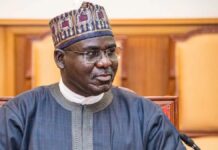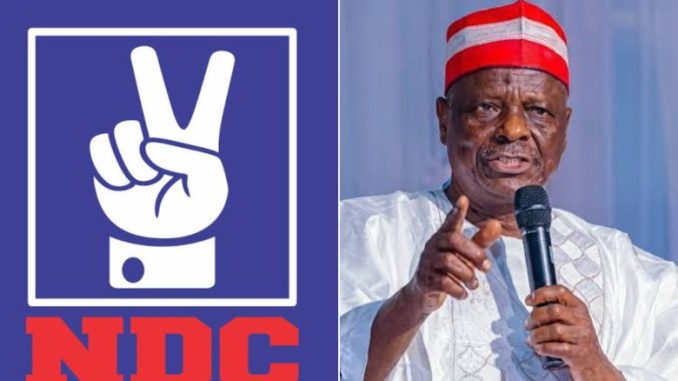
A fresh internal dispute has erupted within the National Democratic Congress (NDC), with reports indicating that the party’s vice-presidential candidate, Rabiu Musa Kwankwaso, is considering his future in the party following a disagreement over candidate nominations in Kano State.
The controversy stems from the rejection and subsequent modification of a list of candidates submitted by the Kwankwasiyya faction, a political bloc aligned with Kwankwaso.
Party sources said tensions escalated after the Kano State chapter of the NDC revised the nominations to reflect an agreed power-sharing arrangement between the Kwankwasiyya group and members of the party’s original structure in the state.
According to a document reportedly signed by Kano State NDC Chairman, Hussaini Isah Mairiga, the adjustments were made to enforce a previously agreed 60-40 formula for the allocation of elective positions and party offices.
Under the arrangement, the Kwankwasiyya bloc was allocated 60 percent of positions, while the party’s pioneer members retained 40 percent.
The revised list resulted in the replacement of several candidates believed to be loyal to Kwankwaso across a number of federal and state constituencies.
The affected positions include nominations for House of Representatives seats and State House of Assembly constituencies in parts of Kano State.
Speaking on the development, Kano NDC spokesperson Ibrahim Waya said the party’s national leadership had directed that the agreed sharing formula be implemented.
According to him, the directive came from the party’s National Leader, Seriake Dickson, in a bid to preserve internal balance and uphold existing agreements among stakeholders.
The decision, however, has reportedly generated dissatisfaction within the Kwankwasiyya camp, where some members view the changes as a deliberate effort to weaken the faction’s influence in the state’s political structure.
On the other hand, longstanding members of the party have accused the Kwankwasiyya bloc of attempting to dominate the Kano chapter following its recent integration into the NDC.
The dispute comes only weeks after Kwankwaso and Peter Obi reportedly joined the NDC from the African Democratic Congress (ADC), emerging as the party’s vice-presidential and presidential candidates, respectively, ahead of the 2027 elections.
The latest disagreement also follows a recent resolution by the party’s National Executive Committee (NEC), which reaffirmed the principle of party supremacy and warned against transforming the NDC into a personality-driven political platform.
In a statement issued after its national meeting, the party directed all affiliated support groups to operate under its supervision and emphasised that elected officials and political appointees must engage party structures before making major decisions.
Political observers say the outcome of the Kano dispute could have significant implications for party cohesion as preparations intensify for the 2027 general elections.